Comparison of Moose, Elk, and Mule Deer
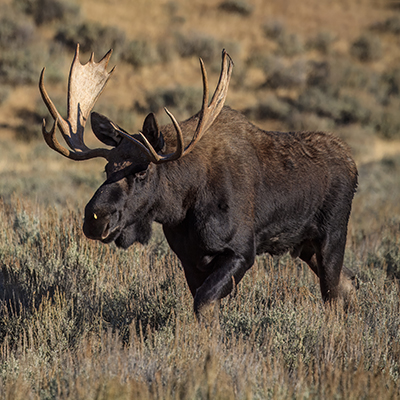
Moose
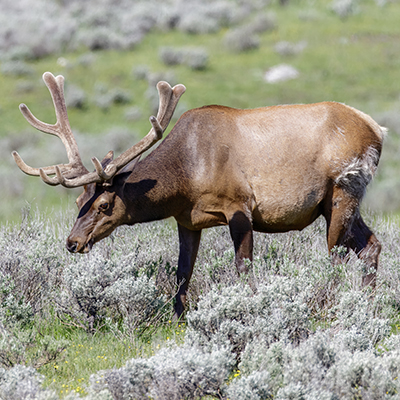
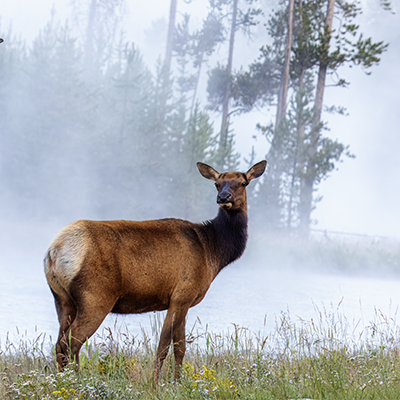
Elk
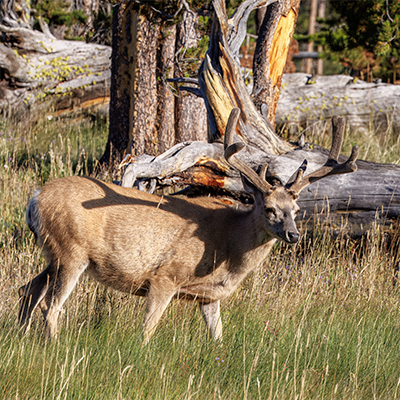
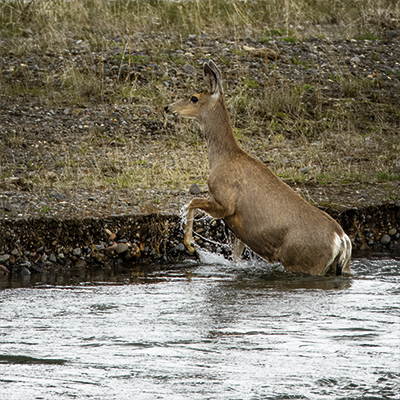
Mule Deer
The moose, elk, mule deer, and white-tailed deer are all members of the deer family that live in Yellowstone. The moose is the largest, the elk is the second largest, the mule deer is smaller than the elk, and the white-tailed deer is the smallest.
Look at the Moose's antlers. Those antlers are called palmate antlers due to their broad, flat, scoop-like shape, which resembles your own palm, where the other deer family member's antlers are branching, pointed antlers.
In the deer family only the males have antlers. To better understand antlers and horn check out this page.
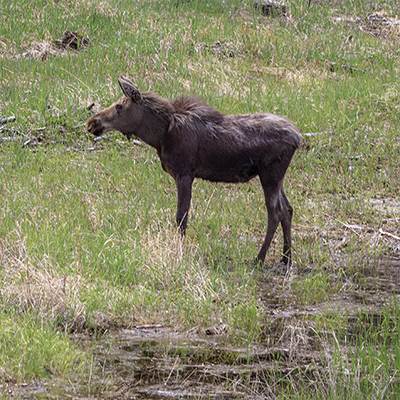
Moose
Characteristics
- Bulls weigh close to 1000 pounds (454 kg) and up to 6.5 feet at the shoulder.
- Females weigh 900 pounds (408 kg) and up to 6 feet at the shoulder.
- Calves weigh 25-35 (11-16 kg) at birth.
- Males shed their antlers late December/early January. They restart growing antlers in April.
- The color of adults goes from golden brown to almost black.
- Moose are the largest member of the deer family.
- Males are called bulls, females are cows, and a baby is a calf.
Elk
Characteristics
- Bulls weigh 700 pounds (315 kg) and are five feet tall at the shoulder.
- Cow's weight: 500 pounds (225 kg) and 4.5 feet tall at the shoulder.
- Calves weigh 30 pounds (14 kg) at birth.
- Bull antlers start growing in the spring and dropping in March or April.
- Color of adults goes from beige (near white) rump, tan body, and darker neck and head.
- Babies are born in late May or early June.
- Males are called bulls, females are cows, and a babies are called a calf.
Mule Deer
Characteristics
- Buck, or male, weighs 150-250 pounds (68-113 kg).
- Doe, or female, weighs 100-175 pounds (45-79 kg).
- Babies, or fawns, weigh 5-6 pounds (2.5 kg) at birth. Births usually produce twins.
- Antlers grow from April to August. They are shed in late winter or spring.
- The ears are huge, and that is where their name comes from.
- Mule deer have a white tail with a black tip. The underside of a White-tailed Deer's tail is all white.
- Males are called bucks, females are does, and a baby is a fawn.